7.07.2011

Characteristics of Good Design

Recently, while speaking at SOWine2, I had the opportunity to enjoy a design presentation given by Richard Roberts, Creative Director at Palazzo Creative in Seattle.  I was pleased to connect a name and firm with some work I'd already admired -- Palazzo did the re-branding for L'Ecole 41, a known Walla Walla based winery, which I saw during the Taste Washington event held in Portland two months ago. 

Richard noted that good design has three key characteristics: consistency, transferability and ability to project extrinsic cues about the brand promise.  For a new brand, design consistency is about keeping look and feel similar throughout all marketing materials.  (In a broader marketing sense this also means consistent messaging, placement and promotion.)  With an established brand like l'Ecole 41, consistency can be more challenging -- with a redesign, there is a question of what design elements should remain the same and what should stay in the past.  I love how Palazzo maintained the brand's iconic school house image, but elevated its positioning by transforming it into a more serious package with less classic color and polished design.

Transferability means that the design works in different mediums.  For wineries, this typically means that it works for logo, packaging, and marketing materials.  A very important area for wineries to consider is how the design will appear on the shelf.  I've seen beautiful work that just doesn't work given the rather small amount of label "real estate" on wine bottles.  Additionally, fonts and nuances need to be easily translated to other marketing arenas.  L'Ecole 41's new website features its revised logo with the new color palette and tone.  An example of poor transferability would be a wine label that doesn't translate to a website, ad or other collateral.

The ability to project extrinsic cues is perhaps the most challenging since it's multi-dimensional.  The l'Ecole 41 label sends a message of an upscale experience that has an element of the old world but is not stuffy.  It speaks to the very good and consistent quality in the bottle.  When designing for a wine brand, you must always consider what message the design is sending, and make sure that it appeals to the audience of buyers you've targeted.

This of course means that you should start with the buyer in mind... in my next post, I'll discuss how to get the most out of your experience working with designers and creatives.

6.20.2011

My WA State Fair Favorites

This month I had the pleasure of judging the Washington State Fair wine competition held annually in Yakima.  Wade Wolfe, noted winemaker who with his wife owns Thurnston Wolf, was my panel's head judge.  Together, the six of us on the panel tasted about 150 wines including white blends, Bordeaux blends, Cabernet Sauvignon and dessert style.

Some of my top scoring wines are listed below. (Note that these are not necessarily the medals awarded by the competition.) 

GOLD
Coyote Canyon Horse Heaven Hill Reserve Cabernet Sauvignon 2008 - smoky raspberry with slight toffee note; nicely oaked with a herbal character.  Good length.

Kiona Red Mountain Cabernet Sauvignon 2004 - raspberry, mocha, peat moss and graphite aromas with cedar, sweet curing tobacco notes;  great structure and length.

Kiona Red Mountain Cabernet Sauvignon 2005 - blackberry, cedar, leather -- a deep, inviting notes with tea leaf notes; rich and ripe on the palate; nice structure and finish -- well integrated.

SILVER PLUS
Maryhill Tudor/Gunkel Cabernet Sauvignon 2008 - inviting notes with cigar box, blackberry, tea leaf; cool herbal note at palate; good structure.

Windy Point Cabernet Sauvignon 2005 - mint, black cherry, boysenberry with a solid structure and pretty finish.

Cougar Crest Cougar Hills Cabernet Sauvignon 2007 - cedar, black fruit, graphite -- very pretty!  A hint of a peppery note with a solid finish.

Vin du Lac Barrel Select Cabernet Sauvignon 2007 - cedar plank, blackberry, tea leaf with a hint of almond; good length.

6.15.2011

Success at SoWine2 - "Secrets" to Creating a Great Industry Event

Yesterday I had the honor and pleasure of presenting "Building a Winning Marketing and Sales Plan" to an enthusiastic audience at SOWine 2.  I was impressed by the enthusiasm, energy and attendance at this second annual event held in Central Point targeting Southern Oregon producers.  In fact, my mind is still racing with thoughts about the knowledge gained from thoughtful audience questions and my colleagues' presentations.

A terrific industry event starts with a strong vision and commitment to planning, organization and service.  It follows through with strong presenters and like a good marketing plan, collects feedback and seeks continuous improvement. If its truly impressive, an event like this leaves attendees and presenters alike feeling energized, connected, educated and ready to take action.

Marilyn Hawkins of Hawkins & Company PR, a b2b PR firm based in Ashland, is the visionary behind SOWine and she gets it!  Marilyn created this event to gather and educate Southern Oregon wine producers (she also owns a small winery there) and her abilities as an event organizer are downright impressive.  This year, to enhance her inaugural program, she partnered with the fast-growing Southern Oregon Wine Institute of Umpqua Community College, directed by the equally energetic Chris Lake.

Below are some of the highlights of my notes:

1. Good design is consistent, transferable, and projects extrinsic cues about the brand promise (the marketing value proposition) - Richard Roberts, Palazzo Creative

2. Don't just "build and blast".  Best practice email marketing starts with a goal, list segmentation, and compelling contest. It includes testing and analysis, focuses on deliverability, and is compliant with CAN-SPAM laws. Terry Miller, CRM Group

3. Consider rotating your email signature to include great press quotes about your winery - Sheila Nicholas, Nicholas Communications

4.  Your social media campaign needs to consider that over 80% of millenials sleep with their smart phones (myself included, although depending on what definition you use, I'm more likely a Gen Xer) - Jeffrey Kingman, Chalkboarder

5.  Before you can build a successful marketing plan, you need to know who you are, to whom you're selling, what differentiates you, when and where you will sell and why anyone should care - moi, Trellis Wine Consulting

Unfortunately, I was unable to stay until the very end of the day, so I missed the late afternoon presentations.  Given my experience at the beginning of the day, I'm confident that they were equally as interesting.  This was a couple of days out of the office well worth taking.

5.18.2011

Portland Business Journal's Take on OR Competition

I recently had the pleasure of being interviewed by writer, Jon Bell, for his Portland Business Journal piece.  I spoke with him about the importance of recognizing the extremely competitive nature of the industry and subsequent need for a strong business plan and marketing effort in addition to great wine that over delivers on value.

Read the full article by visiting my website's News page in the Published articles section.

5.16.2011

What Winery Operators Can Learn from Casino Management

Why look to gaming to provide best practices for the wine industry?  Because we're all in the hospitality industry first.  Many in wine prefer to focus on the product attributes (variety, oak treatment, aging time, etc.), but given the tremendous competition, it is much easier to differentiate and sell profitably given a winery's service attributes (customer experience, club member benefits, etc.). 

Oregon provides a great example -- there is a lot of excellent Pinot Noir produced here.  It tends to be costly, relatively scarce and quite similar from a broad consumer perspective.  It is much easier to differentiate based on the winery's story, tasting room/ customer experience and overall brand sentiment and loyalty.

Just like casino hosts, tasting room staff are on the "front line", dealing with customers daily.  Despite excellent training and customer focus, there will always be problems needing solutions and situations needing service recovery.  To achieve a better return on service efforts, a recent Harvard Business School Working Knowledge Casino Payoff piece recommends "freedom within a framework" approach.

Author Dennis Fisher reports that giving casino hosts more autonomy to make customer service and recovery decisions results in better return on investment and enhanced staff knowledge. For example, a host with five years of experience working in a loosely monitored environment gained 32% better return on comp investment than a counterpart working in a tightly controlled environment ($1.82 versus $1.38 for every comp $1).

Therefore, the researchers found that staff who have the opportunity to learn in a more loosely monitored environment encouraging experimentation with reason make better service decisions leading to bottom line profit.

What types of service policies are in place at your winery?  Do you encourage knowledge acquisition through experience realizing that mistakes will be made, or focus too intently on singular experiences and individual one-time errors?  Do your incentive policies encourage innovative thinking?  Do you recognize and reward customer service recovery efforts?

4.14.2011

The "Score Revolution"


I recently attended a seminar about wine reviewing during the Washington Wine Commission's Seattle Taste Washington weekend.  Panelists included Sara Schneider, Sunset Magazine, Becky Murphy, Director of the Dallas Morning News wine competition, W. Blake Gray, Gray Market Report blogger and moderator, Sean Sullivan of Washington Wine Report.  Each described his system for reviewing wines -- 20 points, medals, 100 points and stars, respectively.

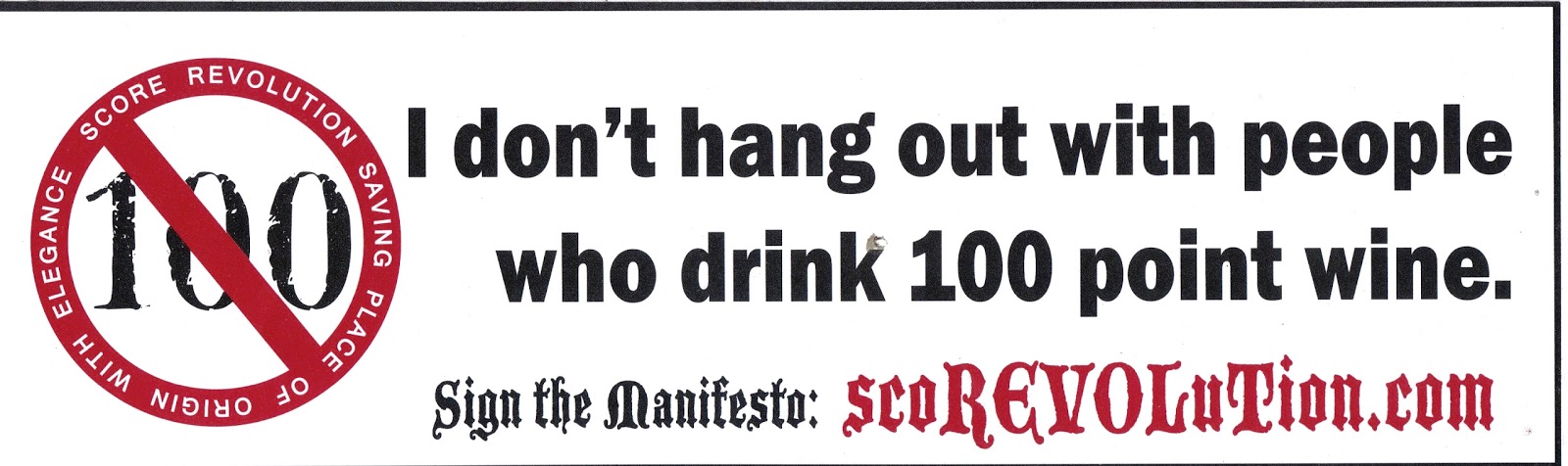
A debate about the value of the 100 point score ensued.  Gray argued that he must use the system because that is what the publications for which he writes desire.  Others argued that this scale is skewed, misrepresents some wines (i.e., the lack of 90+ point Sauvignon Blancs relative to number submitted), and is ultimately damaging to the industry and consumers. Christophe Hedges, from Hedges winery, advocates a complete departure with  "Score Revolution". He eloquently described his goal of eliminating all scoring and passed out the below bumper stickers.  A fun way to create awareness of the effort, but I was just surprised to see that the website to which it referring is under construction with no message nor link to the Hedges page. (As a marketer, I always recommend having your materials complete and consistent before launching anything.)


As is typical in an argument, I seek to understand both sides (I'm not a good debater!). In this particular situation given my present and prior posts in the industry, I can personally relate.  As a wine marketer, if a client's wine scores above 90, I am the first to post it on a wide range of marketing materials -- Facebook, product sheets, e-newsletters to consumers and trade (with additional content, of course), website, etc., etc.   Good scores sell wine, especially to distributors and consumers. Period.

However, as a former wine buyer/sommelier and professional taster and competition judge, I do not like this scale.  It doesn't make sense to me given its breadth -- what is the difference between a 10 and a 69, for example?  I don't want to drink either!  A buyer is paid to evaluate, so it's not surprising that she would have her own scale.  (When I worked selling wine, I respected this -- I always had a score or two handy, but I did not immediately present it to the buyer -- this is simply knowing your audience.)

I've always used a simple 1-2-3, where the 1s are average/not distinctive, 2s are solid/interesting/recommended and 3s are something special.  There are of course rare circumstances where a flawed wine is a 0 and spectacular bottling is a 3+, but the vast majority of wines are in the 1 to 3 range.

I once worked for an owner who insisted that all wines had to be above 90 points.  This frustrated me given the sea of beautiful 87-89 wines that would never make the cut -- I used to joke that I would open a shop next door with all of the sub-90 "rejects".  It also encouraged distributor reps to be less than accurate with their score reporting, which in turn created more work for me going into each of the publication's systems having to verify scores.  Despite working within a policy with which I disagreed, I respected it because it was the owner's prerogative.

As an industry member, I at first had conflicting positions given my experiences.  At the end of the day, the only side of this equation that truly matters is the business side -- once again, demand is the star.  If the buyer or the consumer want scores, they will stay.  If they decide to forgo them given better wine education and more polished palates/confidence, the situation will change.  I think it's wonderful that there are a range of scoring types and styles -- it's a free market of sorts, and it should remain so.

4.10.2011

Time Management & Customer Service

Today I read an interesting article, Inanity of Immediate Response by Daniel Markovitz, Stanford and Ohio State professor. While written for the Institute of Management Consulting (IMC) members, it also applies to wineries, which are first in the hospitality industry and second in wine production.

Markovitz laments the common consultant cry, "I didn't get anything (strategic) done today because I had to respond to my clients". We all get a flood of communication these days, and it is not uncommon to feel overwhelmed by the amount, frequency and desire to respond. Since it doesn't look like the tide will recede, those of us serving clients and customers need to re-think how we process all of this communication.

Your inbox and phone should not plan your day -- your brain should. Just because you receive a communication, it doesn't mean you need to interrupt your work, particularly if you are deep in higher level strategy or an important project. (I typically schedule strategic thinking and planning work in the early morning and conduct it with my calendar and email account logged out to resist the urge to check them.)

Instead of constantly checking email throughout the business day, do so on a regular but timely basis -- say every hour or two, or once in the early part of the day and again at the close. If someone has a true emergency, they will phone.

When phone calls with requests come in, schedule the follow up in your calendar and communicate the timeline to your customer while you have his attention (versus the type A urge to drop everything and handle incoming needs immediately). Excellent service does not have to be immediate.

Managers should speak with staff about communication policies and develop a corresponding protocol. For example, phone calls are returned the same business day and emails within 24 hours. In establishing process, you will help your team prioritize which will enhance efficiency, service and ultimately, case sales!