4.14.2011

The "Score Revolution"


I recently attended a seminar about wine reviewing during the Washington Wine Commission's Seattle Taste Washington weekend.  Panelists included Sara Schneider, Sunset Magazine, Becky Murphy, Director of the Dallas Morning News wine competition, W. Blake Gray, Gray Market Report blogger and moderator, Sean Sullivan of Washington Wine Report.  Each described his system for reviewing wines -- 20 points, medals, 100 points and stars, respectively.

A debate about the value of the 100 point score ensued.  Gray argued that he must use the system because that is what the publications for which he writes desire.  Others argued that this scale is skewed, misrepresents some wines (i.e., the lack of 90+ point Sauvignon Blancs relative to number submitted), and is ultimately damaging to the industry and consumers. Christophe Hedges, from Hedges winery, advocates a complete departure with  "Score Revolution". He eloquently described his goal of eliminating all scoring and passed out the below bumper stickers.  A fun way to create awareness of the effort, but I was just surprised to see that the website to which it referring is under construction with no message nor link to the Hedges page. (As a marketer, I always recommend having your materials complete and consistent before launching anything.)
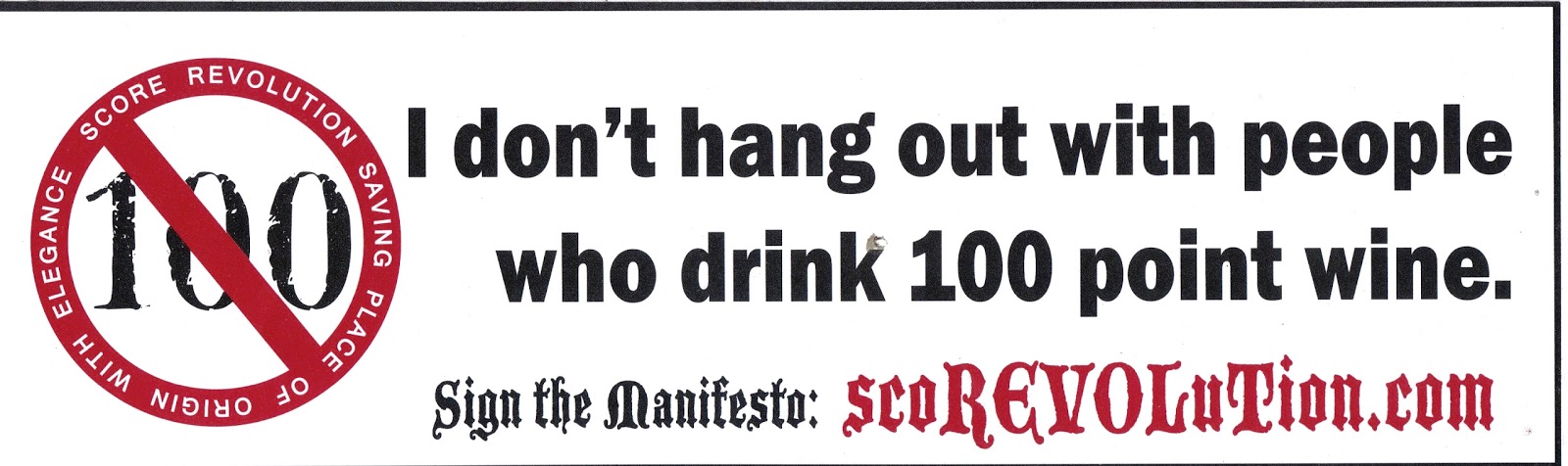

As is typical in an argument, I seek to understand both sides (I'm not a good debater!). In this particular situation given my present and prior posts in the industry, I can personally relate.  As a wine marketer, if a client's wine scores above 90, I am the first to post it on a wide range of marketing materials -- Facebook, product sheets, e-newsletters to consumers and trade (with additional content, of course), website, etc., etc.   Good scores sell wine, especially to distributors and consumers. Period.

However, as a former wine buyer/sommelier and professional taster and competition judge, I do not like this scale.  It doesn't make sense to me given its breadth -- what is the difference between a 10 and a 69, for example?  I don't want to drink either!  A buyer is paid to evaluate, so it's not surprising that she would have her own scale.  (When I worked selling wine, I respected this -- I always had a score or two handy, but I did not immediately present it to the buyer -- this is simply knowing your audience.)

I've always used a simple 1-2-3, where the 1s are average/not distinctive, 2s are solid/interesting/recommended and 3s are something special.  There are of course rare circumstances where a flawed wine is a 0 and spectacular bottling is a 3+, but the vast majority of wines are in the 1 to 3 range.

I once worked for an owner who insisted that all wines had to be above 90 points.  This frustrated me given the sea of beautiful 87-89 wines that would never make the cut -- I used to joke that I would open a shop next door with all of the sub-90 "rejects".  It also encouraged distributor reps to be less than accurate with their score reporting, which in turn created more work for me going into each of the publication's systems having to verify scores.  Despite working within a policy with which I disagreed, I respected it because it was the owner's prerogative.

As an industry member, I at first had conflicting positions given my experiences.  At the end of the day, the only side of this equation that truly matters is the business side -- once again, demand is the star.  If the buyer or the consumer want scores, they will stay.  If they decide to forgo them given better wine education and more polished palates/confidence, the situation will change.  I think it's wonderful that there are a range of scoring types and styles -- it's a free market of sorts, and it should remain so.

4.10.2011

Time Management & Customer Service

Today I read an interesting article, Inanity of Immediate Response by Daniel Markovitz, Stanford and Ohio State professor. While written for the Institute of Management Consulting (IMC) members, it also applies to wineries, which are first in the hospitality industry and second in wine production.

Markovitz laments the common consultant cry, "I didn't get anything (strategic) done today because I had to respond to my clients". We all get a flood of communication these days, and it is not uncommon to feel overwhelmed by the amount, frequency and desire to respond. Since it doesn't look like the tide will recede, those of us serving clients and customers need to re-think how we process all of this communication.

Your inbox and phone should not plan your day -- your brain should. Just because you receive a communication, it doesn't mean you need to interrupt your work, particularly if you are deep in higher level strategy or an important project. (I typically schedule strategic thinking and planning work in the early morning and conduct it with my calendar and email account logged out to resist the urge to check them.)

Instead of constantly checking email throughout the business day, do so on a regular but timely basis -- say every hour or two, or once in the early part of the day and again at the close. If someone has a true emergency, they will phone.

When phone calls with requests come in, schedule the follow up in your calendar and communicate the timeline to your customer while you have his attention (versus the type A urge to drop everything and handle incoming needs immediately). Excellent service does not have to be immediate.

Managers should speak with staff about communication policies and develop a corresponding protocol. For example, phone calls are returned the same business day and emails within 24 hours. In establishing process, you will help your team prioritize which will enhance efficiency, service and ultimately, case sales!

3.17.2011

5 Phases of Consulting Process

I'm often asked by potential clients how I will work with them to get a specific result -- for example, improve distribution in a particular region, gain more media recognition, or improve overall sales. Some people are surprised that my approach to brand development/launch and turn around projects is always the same, even though the individual client needs may be quite different.

Delivering superior client ROI is my goal, so the approach I take to achieving it is very important. After a few years in practice, I'm confident that the Institute of Management Consultant's five phase scientific approach is the best out there. (In January, I began an intensive six month course, which is the first step to achieving the Certified Management Consultant designation recognized in 43 countries and awarded to less than one percent of practicing consultants.) It reflects the methodology I've developed as a brand champion over the years and my belief that marketing-driven wineries are more competitive in today's overly crowded market place.

I begin each engagement with the Entry phase, where I meet with a potential client to learn as much as possible about the company vision, goals, issues and concerns. This is also when I ask a series of questions to assess potential mutual fit and gain an understanding about the scope of the project. Next I deliver a proposal outlining goals, deliverables, scope and fees.

Assuming a contract is signed, the next phase, Diagnosis, begins. In this important research-focused period, I gather data using surveys and informational interviews to assess winery strengths and challenges. Then present a report synthesizing these findings and outlining areas for opportunity and challenge, as well as recommended direction.

The third phase is Action Planning, where I deliver a strategic marketing plan that will guide all winery efforts to achieve the client's goals. This detailed plan outlines the 5 W's (who, what, when, where, why) and how results will be measured.

Sometimes potential clients want me to jump directly to what is the fourth phase, Implementation. (In a few engagements, such as a creating a relatively straightforward website in a more limited project, this is possible, but most integrated marketing communications efforts require the full process.) During implementation, I am typically working with a small team to make sure that what is in the marketing plan gets accomplished.

The fifth and final phase is officially called Termination (I prefer Close or Transition). At this point, I've delivered the project as outlined in the original contract, and either need to transition out or create a new engagement letter.

Operating with a defined process enables me to use best practices, manage expectations, provide realistic timelines and ultimately, deliver results.

3.03.2011

Make Your Winery's Strategy Your Reality

Strategy is critically important in every business. But it is meaningless if it resides only on paper or worse, "in your head". One of the primary challenges of any owner/ operator faces is how to live his business strategy, aligning goals with successful execution.

A few months ago I read an HBS article interviewing the authors of One Strategy: Organization, Planning and Decision Making - Iansiti of HBS and Sinofsky of Microsoft. Their comments were impressive, and I immediately ordered the book.

In One Strategy we learn that companies have two strategies -- one explicit; the other implicit. The former is what's directed by management and visible in presentations and marketing plans. The latter is reality -- the actual execution of the strategy by team members based on their decisions and behavior.

A winery is therefore "living the strategy" when both explicit and implicit are aligned. Iansiti argues that strategy is a function of the way the company operates: "Strategy therefore becomes the product of the firm's incentives, structures, and patterns of behavior, not the other way around."

Are your winery's compensation structure, processes and patterns conducive to rewarding your team for making your intended strategy your reality? If so, you are achieving and operating as you set out to do and adapting to ever present change in your company and the industry. If not, you are likely struggling with issues ranging from increasing inventory, decreasing sales, operational inefficiency and/or team turnover.

In my practice, I specialize in aligning strategy with results. If you are struggling with these issues, contact me (360.210.5551 or info@trelliswineconsulting.com) to discuss how we can work together to help you achieve your ultimate vision, enhancing sales and efficiency.

2.10.2011

Process for Evaluating Marketing Capabilities

In a recent post I discussed the four critical roles of a marketer (instigator, innovator, integrator and implementer) in the context of an article about how GE transformed marketing from a support function to a leading capability driving company growth.

In addition to changing the way it viewed marketing, GE invested time in evaluating its marketing teams and establishing benchmark criteria to guide success and development. Their system can be applied to the way the wine industry evaluates its marketing efforts.

The key capability areas were identified as follows:
* strategy and innovation
* branding and communications
* segmentation and targeting
* value creation and pricing
* sales force effectiveness (this can be internal and external)
* new world skills (think technology, CRM and social media)
* market knowledge
* commercial activation

In each capability area, GE outlines important skills which total 35 for all capabilities. For example, in market knowledge, key skills are the ability to identify trends, collect and manage data, analyze markets and recommend directions.

In breaking down the marketing function into capabilities and relevant supporting skills, wineries can identify strengths, challenges, and areas with competitive advantage. This practice can help focus the person(s) charged with the marketing role toward greater efficacy and efficiency -- leaving more time to build relationships and drive sales.

1.20.2011

The Problem with Bosses

In a recent HBS working paper, Linda Hill, Harvard business school professor and author of the widely read, Becoming a Manager, discusses her latest book, Being the Boss. She outlines three imperatives for managers including self management, team management and network management. Hill also critiques relying on formal authority as a management technique. I look forward to reading her new book and in the meantime, give some thought to what it means to be a boss versus a manager versus or leader.

The word "boss" has always bothered me. It isn't encouraging and seems somewhat dismissive. Perhaps this is because I've heard too many "bosses" use phrases like "because I'm the boss" or ask "who is the boss" rhetorically when their authority is questioned.

It takes only a title to be a boss. To be a manager, you must have a philosophy of team building and development, and work to create an environment that breeds success. To be a leader, you must additionally have a compelling vision and a glowing energy or attractive force made possible by your love of and respect for the "game" and your "players". In the latter two cases, formal authority is rarely, if ever used.

In addition to a compelling vision and motivational style, a strong leader engages his team in creating goals and expectations. When these are co-created versus handed down, "buy in", or true commitment is possible. Once there is a clear game plan, a leader creates a measurement and rewards system, and processes for providing and receiving regular constructive feedback. A strong leader encourages and models integrity, open communication, respect and commitment. She celebrates successes and seeks to gain knowledge from failure versus judge or over react. She works with humility, understanding and empathy, but balances these humanist values with strong business focus. And most of all, she is always learning, seeking to improve her understanding, skill and knowledge base.

1.13.2011

A Winery Leader's Primary Role

Wineries operate with many different structures. Smaller ventures tend to have the "mom and pop" (or just mom or pop) doing everything from vinifying to selling to books. Medium-sized wineries typically either have a President, GM or shared management team, and larger corporations employ officers with ranks of reporting teams and divisions. In every structure type, there is a primary role for the leader or leadership team -- creating and helping implement the vision.

I often write about the importance of operating with a strategic business plan. At the heart of these plans is the leader's vision for success and his or her plan for achieving it. In a recent Silicon Valley Bank blog, Raymond Nasr, Director of Wine Programs, discusses "What Makes Entrepreneurs and Winemakers Tick". He identifies three common elements -- Tradition, Absolute Trust and Struggle, and compares cites examples of best practices in the tech and wine industries.

Wineries are typically pretty good at developing Tradition given the annual celebration of harvest and natural inclination to share great meals with beautiful wines. It's a fun, passionate industry so tradition is almost a given. The only structure type where I've witnessed struggle with meaningful traditions is the corporate winery given the constant M&A activity, role changing and other factors.

Wineries are also naturals at incorporating the Struggle element. Any time Mother Nature is a key player in an industry, there is challenge. Add vineyard maturity, the relative high cost of goods sold and slow inventory turn, and incredible competition necessitating investment in brand marketing and sales, to the equation and the industry is ripe with struggle.

What I find lacking in many wine businesses, especially in small to medium-sized organizations, is the Absolute Trust part of Nasr's equation. To have absolute trust among people, there must be a compelling vision and plan to achieve it. Many operators in the industry are most concerned with the art of producing wine -- not the equally important art and business of selling it. This tendency can create additional financial strain and risk, and human resource issues, further adding to the Struggle and eroding Tradition.

In my practice, I help wineries improve Absolute Trust in three steps: 1)by creating or helping to create a vision and strategic plan; 2) then developing specific goals and performance incentives tied to the plan, which helps focus and align teams; 3) and finally, designing processes to track progress, celebrate successes and swiftly and professionally deal with challenges.

When you have a fully engaged, high performing team, beyond expectations results are both possible and common! And that this starts with the vision and plan should be inspiring to owners and operators -- it's very doable, just a matter of whether you are willing to commit to the process.